
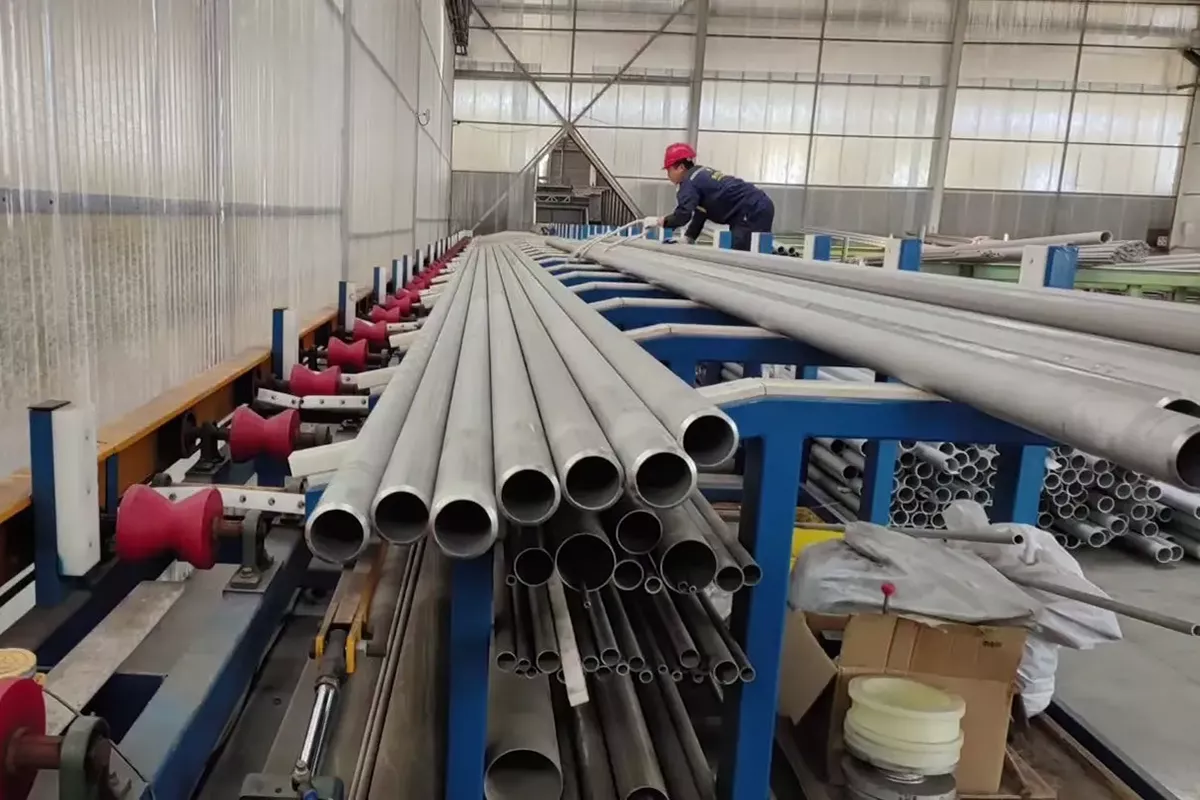
ASTM A213 / ASME SA213 TP316 stainless steel tubes and pipes are designed for high-temperature and high-pressure heat transfer systems, and are widely used in boilers, condensers, superheaters, and various heat exchanger equipment. Compared with ASTM A312 pipes, A213 places greater emphasis on dimensional accuracy, thermal efficiency, and structural stability under extreme service conditions.
As a professional stainless steel pipe manufacturer, the TP316 stainless steel tubes and pipes we supply are industrial-grade seamless products, particularly suitable for critical engineering projects that require excellent weldability, superior intergranular corrosion resistance, and long-term durability in chemical media environments.
In terms of standards, ASTM A213 imposes stricter control over outer diameter (OD) tolerances and wall thickness tolerances. This ensures higher sealing reliability when tubes are expanded into tube sheets or welded, reducing the risk of leakage. Meanwhile, under operating temperatures up to approximately 550°C, the material maintains a good balance of creep strength and formability, making it suitable for medium-to-high temperature heat transfer applications.
In manufacturing, TP316 tubes are typically produced using seamless processes, fundamentally eliminating the potential weak points associated with welded joints under high temperature and high pressure. Combined with cold drawing processes, the tubes achieve higher dimensional accuracy and smoother internal surfaces, which reduces fluid resistance, improves heat transfer efficiency, and minimizes scaling and blockage risks.
From a chemical composition perspective, TP316 stainless steel achieves an optimized balance of chromium (16–18%), nickel (10–14%), and molybdenum (2–3%). This composition not only stabilizes the austenitic structure but also significantly enhances corrosion resistance and pitting resistance in chloride-containing and high-temperature environments.
Therefore, ASTM A213 / ASME SA213 TP316 stainless steel tubes perform exceptionally well in power generation, petrochemical, and industrial heating systems. They can operate reliably for long periods under high temperature, high pressure, and corrosive media conditions, making them an ideal choice for critical heat transfer equipment and demanding piping systems.
| Specification | Range / Details |
| Outer Diameter (OD) | 6.0 mm – 426 mm |
| Wall Thickness (WT) | 0.5 mm – 13 mm |
| Length | Customizable according to client requirements |
| Surface Finish | Pickled, Annealed, Polished |
| Material Standard | ASTM A312 / ASME SA312 |
| Typical Grades | TP316 (UNS S31600) |
| Element | Content Range | Function / Description |
| Carbon (C) | 0.04 – 0.08% | Optimized for high-temperature strength |
| Chromium (Cr) | 16.0 – 18.0% | Provides oxidation resistance |
| Nickel (Ni) | 10.0 – 14.0% | Stabilizes austenitic structure |
| Molybdenum (Mo) | 2.0 – 3.0% | Enhances pitting corrosion resistance |
| Manganese (Mn) | ≤ 2.0% | Improves hot working properties |
| Silicon (Si) | ≤ 1.0% | Aids in deoxidation and strength |
| Phosphorus (P) | ≤ 0.045% | Impurity control for toughness |
| Sulfur (S) | ≤ 0.030% | Improves machinability (limited content) |
| Property | Minimum Requirement |
| Tensile Strength | 515 MPa (75 ksi) |
| Yield Strength (0.2% offset) | 205 MPa (30 ksi) |
| Elongation (in 2") | 35% |
| Hardness (Brinell) | ≤ 217 HB |
| Creep Rupture Strength | 100 MPa at 650°C (1202°F) for 10,000 hours |
Intergranular corrosion is one of the most common forms of corrosion after welding, especially under high-temperature thermal cycling or in chemical media environments. TP316 material adopts a low-carbon design (especially TP316L), which effectively reduces carbide precipitation at grain boundaries after welding, thereby significantly reducing sensitization tendency and improving intergranular corrosion resistance. This characteristic is particularly critical for long-life welded structures, especially in chemical plants, heat exchangers, and heat transfer systems.
We conduct strict microstructure inspection and corrosion testing on each batch of tubes before shipment to ensure that the products maintain a high level of corrosion resistance even after welding. This not only reduces on-site rework and maintenance costs but also significantly improves the long-term stability of the system.
TP316 belongs to the austenitic stainless steel family, containing 16–18% chromium, 10–14% nickel, and 2–3% molybdenum. The addition of molybdenum significantly enhances resistance to pitting and crevice corrosion. Compared with 304 stainless steel, the 316 series offers superior corrosion resistance in chloride-containing environments, which is particularly important for chemical and marine applications.
During manufacturing, we strictly control the chemical composition and heat treatment processes to ensure a stable microstructure. This not only improves corrosion resistance but also enhances the performance of the heat-affected zone during welding. As a result, the finished tubes maintain excellent weldability and formability across multiple welding processes (such as TIG, MIG, and manual arc welding). Good weldability reduces the risk of cracking, deformation, and thermal stress concentration, improving the overall reliability of the piping system.
The seamless structure and optimized alloy composition of TP316 provide significant advantages for critical heat transfer systems:
As a manufacturer, our production process covers the entire quality control chain, including raw material inspection, precision forming, heat treatment, and non-destructive testing. All delivered products can be supplied with complete material test certificates (MTC), chemical composition reports, and mechanical property test results, ensuring that each TP316 tube complies with ASTM A213 / ASME SA213 standards.
Q: What is the maximum operating temperature of ASTM A213 TP316 tubes?
A: TP316 stainless steel tubes can operate continuously up to 870°C (1600°F) in oxidizing environments. For reducing environments or applications involving thermal cycling, please consult our technical team for temperature limits based on your specific operating conditions.
Q: How does TP316 compare with TP304 in boiler applications?
A: TP316 performs better than TP304 in high-temperature boiler applications, mainly due to its molybdenum content. Molybdenum improves creep strength and corrosion resistance. TP316 is especially suitable for applications involving chloride-containing feedwater or flue gases, with pitting resistance improved by up to 50%.
Q: Are TP316 tubes available with cold-drawn finishing?
A: Yes, we offer both hot-finished and cold-drawn options. Cold-drawn tubes provide tighter tolerances and smoother surfaces, making them ideal for heat exchangers that require precise flow characteristics and higher heat transfer efficiency.
Q: What tests are required to comply with ASME standards?
A: Our ASTM A213 TP316 steel tubes comply with all requirements of ASME Section I and Section VIII, including:
Explore our full range of stainless steel grades for pipes and tubes, including TP304, TP316, TP321, duplex, and super duplex materials.
Need a Quote or Technical Support?
Contact us for fast quotation and expert guidance.
Get a Quote